Showing posts with label dr. andy smith. Show all posts

Saturday, April 29, 2017

Cheese vs. Cheese Food
What's the Difference?
Once again, looking at nutrition we start with my Mom, Diana.
 
Going shopping as a kid, my Mom always stopped us from buying Cheese Food, Cheese Food Product, Cheese Food Snack and Pastuerized Process Cheese Food (PPCF) along with any other deviants from "Cheese." So, what's the difference?

 
According to the Sargento Company website cheese is 100% cheese and cheese food or PPCF is something with a minimum of 51% cheese as an ingredient. Ouch.
Thus the name Kraft Singles on the package above. At least the PPCF is clearly noted after the word American on the label.


The Sargento website goes on to say that the following steps are how Processed Pasteurized Cheese Food/PPCF is created:


1. The process starts with a minimum of 51% real cheese.
2. This is ground down and may be mixed with any of the following items including artificial coloring, flavoring, other dairy ingredients, water, salt and mold inhibitors.
3. The mixture is heated to at least 150 degrees Fahrenheit for at least 30 seconds.

4. While heating, emulsifiers and acidifiers may be added.
5. The final product, with a minimum of 51% real cheese, is individually wrapped in plastic creating the Pasteurized Process Cheese Food (PPCF) found in the dairy department of your local supermarket.
 
"White American" what?
Pasteurized Process Cheese Product according to the small print on the side of the front label!
 
Now I am not saying the PPCF and similarly named items don't taste good, aren't less expensive sometimes, aren't easier to separate slices or don't have some nutritional value. I do think we should look over the ingredients list when purchasing. Or, as my Mom would say, "no, we can't buy that. It's not real cheese."
 
 
Here is the list of ingredients in Kraft Singles according to the Huffington Post along with some editorial comments by me in blue ink:
  • Cheddar cheese (milk, cheese culture, salt, enzymes)
  • Whey (by-product of the production of cheese. It is what's left when the cheese curdles are strained)
  • Water
  • Protein concentrate (what is that exactly?)
  • Milk
  • Sodium citrate (more salt)
  • Calcium phosphate (according to Rodale Organic Life, and researcher Janeen Leon, high calcium phosphate levels are associated with higher mortality and kidney disease rates, heart disease, weakened bones and decreased Vitamon D activity.)
  • Milkfat
  • Gelatin
  • Salt (more salt)
  • Sodium phosphate (more salt and see the problems listed above with calcium phosphate)
  • Lactic acid as a preservative (Does lactic acid sound familiar? It's the waste product from muscles that causes leg cramps)
  • Annatto and paprika extract (used for color and only small amounts but these two items actually have some mild nutritional value)
  • Enzymes
  • Vitamin A palmitate (hey, a little nutrition added!)
  • Cheese culture
  • Vitamin D3  (hey, some more nutrition added!)

  • I would like to add at this point that when deciding on which cheese to eat often opt for the harder cheeses. Why?
    1. They have generally have required more enzymatic reaction to create  so in essence they are "pre-digested" making them more easily digested when eaten and therefore often produce less gastric upset.
    2. They are often  made in smaller batches with less "chemicals" and additives.
    3. They are less often artificially softened.
    The nerves of the spine help regulate
    digestion and elimination
    4. We have a lot of new patients come to the office saying they can not tolerate dairy. The Chiropractic adjustment often helps their digestion which in combination with picking less artificially produced cheeses and decreasing amounts and frequency of eating dairy allows the person to return to eating dairy if they choose.
    5. There is debate over the nutritional necessity of eating dairy:
       Pro- source of calcium, potassium, Vitamin B-12 and helps regulate phosphorous in the boday, source of protein and fat.
       Con-sometimes hard to digest, not highly absorbable form of calcium in milk, common allergies and intolerances to milk, weight gain association.
    Not sure what is best for you? Contact me here on the BLOG or call for a free 15 minute phone consultation.


    Monday, December 19, 2016

    Increase Energy and Decrease Inflammation in Minutes A Day (and at very low cost!)
     
    25 years ago when I was an intern at the New York Chiropractic College Outpatient Clinic in Levittown, Long Island I would read the latest medical research and tell my patients that in 25 years I believed their doctors would more and more treat their diseases not by looking at their symptoms or diagnosis as much as looking to lower inflammation in their body. This, of course, made great sense to me as I was trained as a Chiropractor to look to the cause of the problem and not just at eliminating symptoms. That focus on cause correction plus the research showing that heart disease and so many other problems in the body were created or at least exacerbated by inflammation made the conclusion a no-brainer. My observation that research often seemed to take 25 years to "get into the field" made me excited for the day that patient care would improve by leaps and bounds as people's troubles would be cared for in a much more effective, speedy and intelligent way. Unfortunately, the truth is I'm still talking about the future of medicine 25 years later without much change in the medical approach. Please understand I am not taking a shot at medicine but rather hoping for a better future for mankind and allowing all of those wonderful and talented minds that enter medicine to better take care of their patients.
     
    First we must relize that stress, inflammation and acid levels in our body are NOT synonymous but ARE very much related.
     
     
    Physical, emotional and chemical stress all eventually create acid and inflammation. Oddly, acid can lead to inflammation and stress while inflammation can lead to acid and stress so they all tend to make each other worse.


    We can try to lower stress but we also need to figure out ways to better deal with stress, inflammation and acid and the havoc these 3 create in our body.
     
     
    One might be tempted to take an anti-inflammatory medication but these medicines are generally not recommended for long-term use due to side-effects and long-term use could disrupt immunity and tissue repair as the white blood cell function is curtailed by the use of anti-inflammatory drugs. (White blood cells help us to fight infection. The inflammatory process also helps remove damaged tissue so that our body can repair itself by replacing the damaged tissue with healthier cells.)


    What can you do today? Scroll Down.
     
    After trying to lower stress and decrease actions that cause inflammation we are still often in trouble. The good news is that since stress, inflammation and acidity levels are related, lowering one can help lower all three and while it may be difficult to lower many types of stress and inflammation directly it is relatively simple and inexpensive to reduce acidity levels in the body on a daily basis. How? Eat foods that decrease acid levels.
     
    Less Acid is also called Increased Alkalinity.
     
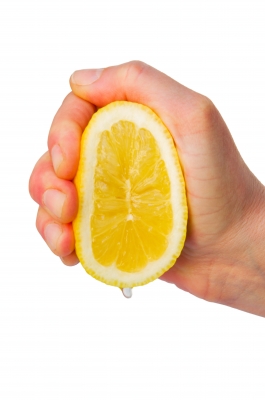
    Can you squeeze a lemon?
    One of the least expensive and simplest foods to prepare that decreases acid in the body is fresh lemon juice squeezed into water. Drink on an empty stomach. Wait at least 20 minutes to eat your meal. Seems odd, I understand, to add the acid of a lemon to get less acidic. This works when taken without food and preferably on an empty stomach. We drink the lemon water and apparently the brain senses the increased acidity and signals the kidneys to remove acid from the blood leaving the body with less acid aka more alkaline. (This apparently is the mechanism for apple cider vinegar, also. Doesn't taste as good but feel free to do a shot of ACV instead of the lemon water if you choose.)
     
    Try this daily for a month and let me know if you feel more energy, less achiness and pain, enjoy better sleep, feel stronger immunity and maybe even take off a pound or two.
     
    Want more ideas on decreasing acid, inflammation and stress? See Part II of this series.

    Saturday, January 9, 2016

    My Mom and the Dorito Effect-Part 3-The OJ Connection


    My Mom and the Dorito Effect, Part 3

    The OJ Connection

     
       Growing up we usually made orange juice from those cans of concentrate sold in the frozen aisles of supermarkets. Just add water, stir and you have it. Plenty of nutrition and good taste.

    Of course there were those Sunday mornings without school and some other special meals that my Mom or Dad and later us kids would make the best tasting juice of all...fresh squeezed!


    Until we found out about a great innovation:

    "Not From Concentrate"


     "Not From Concentrate" absolutely seemed to be the best of both worlds. Great taste, great nutrition and no work. My family, like many other familes, have certainly invested a lot in "Not From Concentrate" (NFC) over the years but it certainly seemed worth it to get that great nutrition and taste with no muss, no fuss. Then  a couple of years ago my patient Michele came to me one day to discuss "flavor packs." She educated me about a book written by Alissa Hamilton in 2009 called Squeezed: What You Don't Know About Orange Juice that discusses a so-called dirty little secret of the orange juice industry.

    Fresh squeezed orange juice unfortuantely has a very short shelf life. Add to this issue that the orange harvest season in Florida is only October through April. That leaves half a year without fresh squeezed Florida orange juice on the shelves. The juice suppliers came up with a solution. Pouring the juice into a large aseptic storage tank and removing the oxygen allows the juice to be stored up to a year without going bad. The problem is that removing the oxygen also removes the flavor. "Flavor packs" are created from the skins of the orange. Essential oils and essences are removed from the skins and put back into the juice prior to bottling. This includes the use of deriving chemicals like ethyl butyrate from the orange skin and using the expertise of fragrance manufacturers to create a juice that tastes the same whether purchased in spring, summer, fall or winter. Think about it. When you juice those oranges at home you usually get a great tasting juice. Go back to the supermarket next week and buy the same oranges and the juice tastes different. Try a different variey and the juice tastes different. Squeeze oranges at home from Florida, California and Brazil and the juice you make tastes different. Read the orange juice box label and you'll often see that the oranges for "NFC OJ" often come from Brazil. Yet that glass of Pure Premium Tropicana or No Pulp Minute Maid and most of the other "Not From Concentrate" juices taste the same month after month year after year regardless of rainy weather,early frost or any other conditions. The use of the flavor packs also allows the manufacturers of the juice to market a consistent, preferred taste. Yes, just like the tomato soup and the fast food burgers.


    Interestingly, the orange peel does include healthy nutrients, like anti-oxidents, fiber, vitamin C and pectin, but whether the addition of the peel is helping us is assuming we are not consuming additional pesticides in the peel. Since the major juice manufacturers do not like to address the flavor pack issue and the FDA does not require the listing of the chemicals derived from the skin (because technically all of the ingredients come from oranges) we do not currently know if the flavor packs affect the nutritional value of what we buy at a premium over the cost of the frozen juice from concentrate. I do think the public should be aware of the process and keeping the public in the dark is at least a deceitful type of practice allowed at this time under rules of the FDA. Again, we can look back at my Mom's observation from forty something years ago and realize that "something is being done" to our food supply.

    To be continued...Next, that Dorito thing.


    Monday, October 6, 2014


    It’s like he isn’t even listening.”

    “She knows it in class but can’t do it on tests.”

    “Would you stop shaking your leg for five minutes.”

    “I have to take the tags off the back of all his shirts.”

    “I want to help her more but I don’t know how.”

    For many parents phrases like these are uttered or at least thought of too often in any given week.

    Sensory Processing Disorder (SPD)

    Sensory processing disorder (SPD) is a growing problem where the child has normal vision and hearing but can not properly process the information. This problem can stand alone or be combined with and exacerbate learning disorders, emotional or behavioral problems, ADD, ADHD, Asperger’s, and autistic spectral disorders.

    How Can Chiropractic Help?

    Chiropractic can improve the brain’s processing of the senses: sight, hearing, touch, taste and smell. Each Chiropractic adjustment (treatment) also improves  proprioception and vestibular function. These two often overlooked senses allow for the body’s sense of position, motion, balance, coordination and more. Improved sensory processing often results in better school achievement, social interaction, self-esteem, improved sleep, well-being and lower stress for the whole family.

    Join Dr. Andy, a NJ Family Favorite Kids Doc, for a special presentation, Natural Ways to Help Improve Sensory Processing Disorder on Saturday, November 15, 2014 from 12-1 pm. The program will provide information on how Chiropractic and other natural therapies can help and includes a free book for parents and refreshments. RSVP 973-625-2600 or denvillejenn@optimum.net